The 10,000x Engineer and the elimination of middle management
Is Your Company an Organization or an Intelligence System? The era of "AI as a tool" is officially over. We are entering the age of the 10,000x Engineer, where a single builder, synthesized with agentic systems, can out-scale entire departments. In my latest post, I break down why the "productivity loop" is a trap for incumbents and how the true AI-native company operates: The Death of Human Middleware: Why routing information through managers is a structural inefficiency. From Coder to Factory Manager: How software is moving from manual implementation to high-leverage specification. Token Maxing: Why your API bill should be "uncomfortably high" while your headcount stays lean. If you’re still thinking about AI as a "copilot" rather than your company's Operating System, you're architecting for extinction. It's time to break your priors and rebuild for the velocity mandate. Read more about the architectural shift defining the next generation of startups. #AINative #FutureOfWork #10000xEngineer #NeurogenesisSolutions #AIStrategy #BusinessAutomationdescription.
4/28/20264 min read
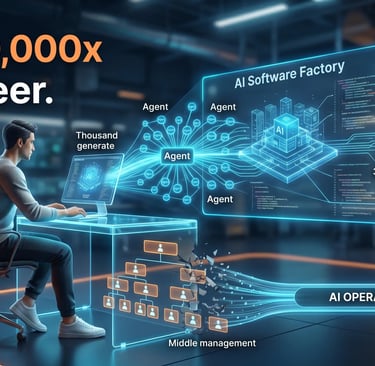
The 10,000x Engineer and the Death of Middle Management: Building an AI-Native Company
1. The Paradigm Shift: AI as the Operating System, Not the Tool
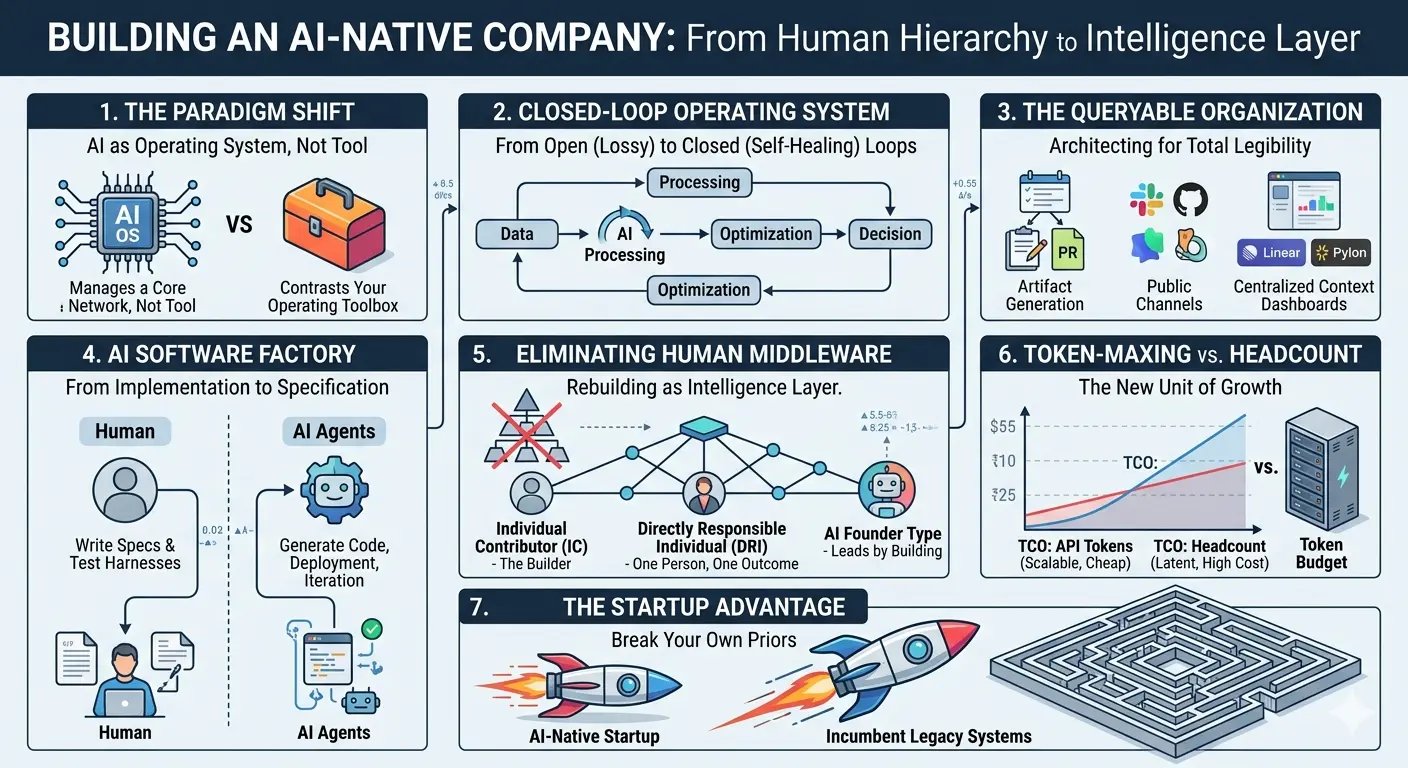
The prevailing discourse around Artificial Intelligence is currently trapped in a "productivity" loop—a categorical error that will lead to the extinction of incumbents. Most founders view AI as a digital assistant or a "copilot" grafted onto legacy workflows to ship features incrementally faster. This framing fundamentally misses the architectural shift: we are transitioning from a world where AI is a tool we use to a world where AI is the operating system the company runs on.
The central thesis of the AI-native company is structural, not incremental. AI doesn't just accelerate how software is built; it dictates the fundamental geometry of the organization. A single engineer, synthesized with a self-regulating system of agents, can now achieve capabilities that previously required entire departments. To capture this value, leaders must stop thinking about headcount and start rebuilding their firms as intelligence layers rather than human hierarchies.
2. From Open Loops to Closed-Loop Operating Systems
In the legacy world, companies operate as "open loops." Decisions are made, execution follows, and the resulting data is fragmented, manually interpreted, and rarely fed back into the system with precision. Open loops are inherently lossy; they are prone to error, information decay, and strategic drift.
An AI-native company is designed as a closed loop a self-regulating control system that continuously monitors its output and adjusts its processes to meet stated goals. This architecture is built for correctness and stability, not just velocity. With self-improving agents, every workflow becomes a self-healing feedback cycle.
"Every workflow, every decision, and every process should flow through an intelligent layer that is constantly learning and improving."
3. The Queryable Organization: Architecting for Total Legibility
To function as a closed loop, an organization must be "legible" to AI. Agents require the same context as a human employee, if not more, to execute a high level of reasoning. This necessitates making the entire organization queryable by default through aggressive artifact generation:
Artifact-First Culture: Every meeting is recorded via AI notetakers; DMs and private emails are minimized in favor of public channels where agents are embedded.
Centralized Context: Custom dashboards are built for every vertical—revenue, sales, engineering, hiring, and ops—ensuring the data is structured for agentic consumption.
Consider engineering management: when an agent has access to Linear tickets, Slack channels, customer feedback from tools like Pylon, GitHub repos, and sales recordings, it can analyze what was actually shipped versus what the market required. This eliminates "lossy" status rollups from middle managers. High-velocity teams using this "Queryable Org" model have seen engineering sprint times cut in half while getting nearly 10x more done.
4. Software Factories: Moving from Implementation to Specification
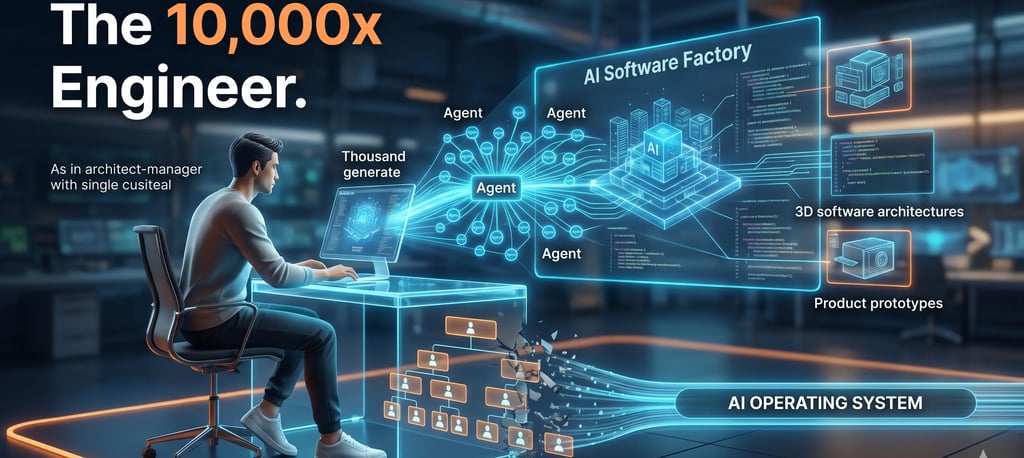
We are witnessing the evolution of Test-Driven Development (TDD) into "AI Software Factories." In this paradigm, the human role shifts from the manual labor of implementation to the high-leverage roles of specification and judgment.
In an AI software factory, the human writes the specs and the scenario-based test harnesses that define success. AI agents then generate the implementation and iterate on the code until it meets a probabilistic satisfaction threshold. Strong DM’s AI team has already pioneered this, reaching a point where their repositories contain virtually no handwritten code—only specs and validations.
This is the path to the "10,000x engineer" envisioned by thinkers like Steve Jay. By surrounding a single builder with a system of agents, you move the individual from being a coder to being a factory manager. The era of the thousand-x or even 10,000x engineer is no longer a theoretical upper bound; it is a mechanical reality for those who stop writing code and start writing requirements.
5. Eliminating Human Middleware: The Velocity Mandate
Traditional management hierarchies exist to route information up and down an organization. In an AI-native firm, this "human middleware" is an architectural inefficiency that creates latency. Velocity is directly proportional to the removal of human routing layers. Following the model Jack Dorsey has implemented at Block, the organization is rebuilt as an intelligence layer with humans at the edge, rather than coordinators in the middle.
This shift defines three new employee archetypes:
The Individual Contributor (IC): The builder-operator. In an AI-native firm, everyone builds. Support, sales, and HR don't just talk; they bring working prototypes to meetings.
The Directly Responsible Individual (DRI): Focused strictly on strategy and customer outcomes. This is not a classic manager; it is one person responsible for one specific result—one person, one outcome, no hiding.
The AI Founder Type: The leader who builds and coaches by example. The founder must be at the forefront, sitting with agents and coding tools to break their own priors about what is possible, rather than delegating AI strategy.
6. Token-Maxing: The New Unit of Growth
The financial model of the AI-native company represents a total reversal of pre-AI scaling. Historically, headcount was the primary proxy for capability. Today, the most effective companies are "token-maxing."
This involves maintaining an uncomfortably lean team in engineering, design, and admin while being perfectly comfortable with an "uncomfortably high" API bill. From a Total Cost of Ownership (TCO) perspective, tokens are cheaper than benefits packages, equity, and human latency.
"Maximizing token usage, not headcount, will be the critical shift."
By replacing expensive, manual processes with high-frequency AI iterations, startups can achieve outsized results with a fraction of the traditional staff.
7. Conclusion: The Startup Advantage
Early-stage founders have a massive structural advantage over incumbents. Large companies are paralyzed by legacy systems, entrenched org charts, and the impossible task of retraining thousands of employees. For an incumbent, changing a core process risks breaking the entire business.
Startups have no such constraints. You can design your workflows, your culture, and your systems around AI from day one. To win, you must stop seeking marginal gains and instead use these tools until you "break your own priors." The opportunity is to build a company that is not a hierarchy, but an intelligence layer—one that operates a thousand times faster than anything that came before it. Is your company an organization of people, or is it an intelligence system that happens to have people at the edge? The answer will determine your survival.